2025-06-13
 0
0

Private automobiles increase individual mobility, but collectively they exact a quiet toll on urban wellbeing. Linking higher car prevalence to diminished happiness, this research argues that urban planning success should be judged first by residents’ quality of life — not by vehicle counts or lane capacity.
Blog • 15 June 2025 • Urban Economics
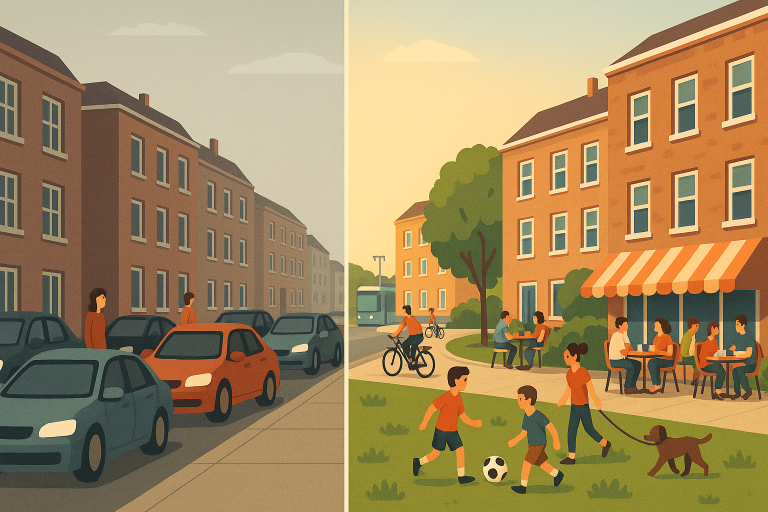
Wide roads and plentiful parking have long been shorthand for progress, but the most “developed” cities according to this measure often score poorly on a simpler metric: how happy their residents feel. Existing research offers clues but no definitive answer. It is found that stressful commutes[1], scarce greenery[2] and chronic traffic noise[3] lower wellbeing. At the individual level, new evidence from the U.S. links heavy car dependence – meaning alternatives are poor – to lower life satisfaction[4]. What remains unclear is whether a city where cars dominate the streetscape through highly present traffic, kerb parking, and wide roads, depresses subjective well-being, regardless of personal reliance.
By pairing Eurostat life-satisfaction data with a new multi-component Car-Friendliness Index for European cities, this study answers that question.
The headline result is stark: controlling for income and year effects, a one-standard-deviation increase in car friendliness is associated with a decrease of roughly two percentage points in the share of residents who are “fairly” or “very” satisfied with life. Satisfaction with public or green space also receives a penalty.
The following sections explain how the index was built, present the regression evidence, and discuss what these findings mean for people-first urban planning.
Data and Construction of the Car-Friendliness Index
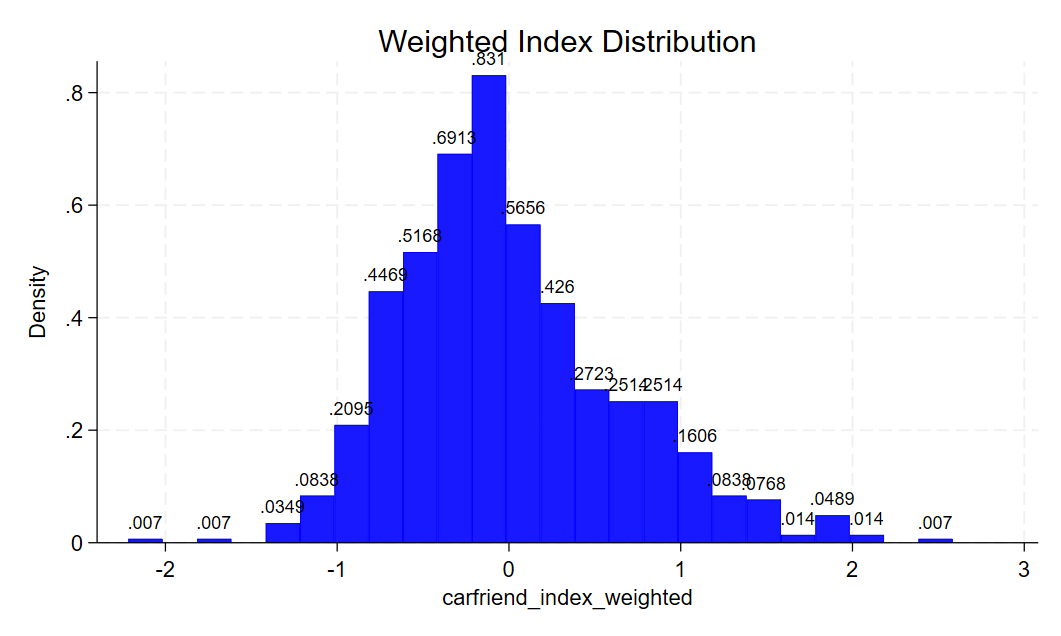 To measure how strongly each city is oriented toward private automobiles, I created a Weighted Car-Friendliness Index (CFI) which blends four z-standardised measure averaged across years of car prevalence and infrastructure priority:
Car ownership per 1 000 residents, share of commuters who drive, average car commute length, and road-network density. The first three indicators come from Eurostat’s 'urb_ctran' panel (2015-2023). Road-network density was generated from an OSMnx script which used all available Eurostat city polygons, downloaded the OpenStreetMap “drive” network, dissolved multilane geometries, summed edge lengths, and divided by built-up land area.
Figure B1 (right) shows how the new Car-Friendliness Index is distributed across the 720 cities in our sample.
Coverage varies: 457 cities have only ownership data; 110 have two indicators; 114 have three; just 39 have all four. To keep as many cities as possible while rewarding richer datasets, I applied a coverage-sensitive weighting rule: ownership carries 100 % weight when alone, falling to 70 %, 60 %, 55 % as additional metrics appear; residual weight is distributed evenly.
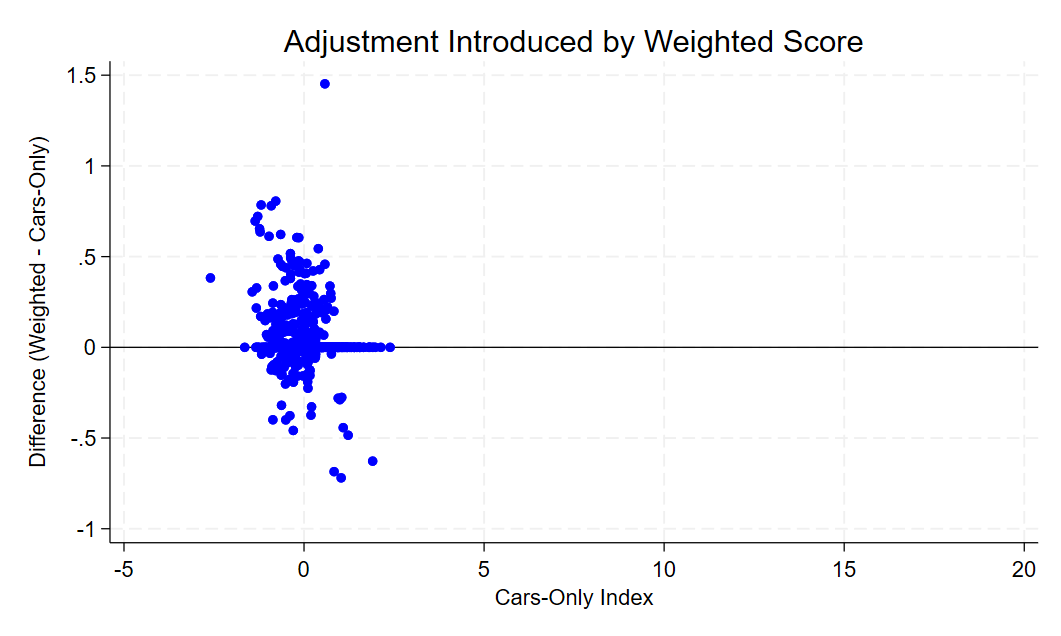 The index is Gaussian and highly correlated with a cars-only score while adding behavioural and infrastructural nuance (Figure B2, left). Two implausible outliers[8] were removed.
Outcome and control variables are also from Eurostat. Life-satisfaction and environmental perceptions come from urb_percep, income data comes from urb_clivcon.
Because Eurostat collects life-satisfaction data only for a subset of urban territories, matching all variables trims the final sample to 75 cities.
Robust OLS models progress from a cars-only index with average income to the weighted CFI with median income, median income squared (to capture potential non-linear relationships with the dependant variable) and year fixed effects; Model 12 adds noise- and air-satisfaction.
Results
The regression evidence confirms a strong, negative link between higher automobile presence and urban wellbeing. The first central specification (Life satisfaction on the weighted CFI with median income and year FE) shows that a one-SD rise in CFI lowers life satisfaction by ≈ 1.9 points (β = –1.864, SE 0.60; Adj. R² 0.298). 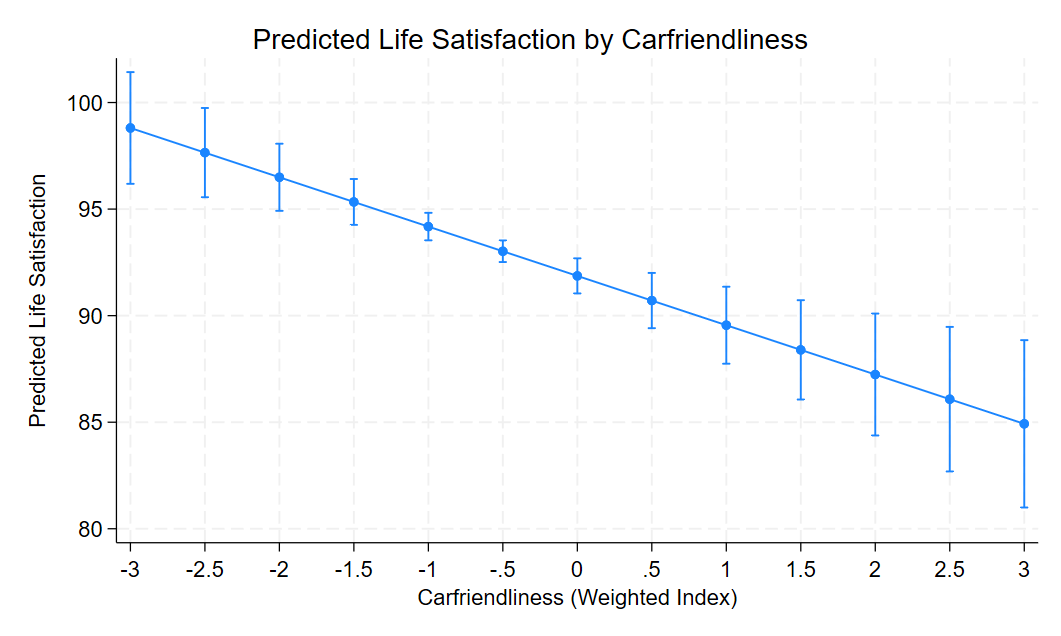
Adding noiseand air satisfaction (Model 12, Figure B4, right) increases the coefficient to β = –2.31 (SE = 0.54) while lifting the model fit to an Adj. R² of 0.49.
Noise enters positively and significantly (β ≈ 0.33); air quality is small and non-significant. Median disposable income remains a strong positive predictor of life satisfaction across specifications, while the squared term enters negatively but insignificantly.
Additional domain regressions show that the CFI is similarly damaging for public-space and more damaging for green-space satisfaction (β ≈ –4.4). Together, these results indicate that car-centred cities hurt both general wellbeing and the enjoyment of civic space.
Interpretation and Mechanisms
While recent research[13] already revealed the social cost of car dependence, the found negative correlation shows that merely a higher presence of cars and their supporting infrastructure carries a significant happiness penalty.
Cars crowd out green and public urban areas and reduce citizens’ enjoyment of the existing recreational spaces.
Both Gehl and White et al.[14] have shown that pavements with greenery and café frontages invite lingering and conversation, whereas traffic corridors do not. Social encounters, child play, and casual neighbourhood life are displaced by traffic flows and parking infrastructure. Connecting the main models to domain regressions, we therefore interpret a loss of shared civic space as the main reason for the lower life satisfaction.
Sensory stress also explains much of the wellbeing gap. Traffic noise explains a sizeable share of the negative relation, consistent with medical evidence on chronic exposure[16]. Lower coefficients for air-quality perception show that it weighs on happiness mainly through health rather than daily awareness – despite lower correlation, research[17] shows that a quieter, cleaner street offers a public-health dividend as well as a happiness gain.
Policy Implications: Put People First, Not Throughput
Success for cities should be measured differently. Adding well-being and accessibility metrics to transport appraisal can help to find issues and solutions quicker.
Reclaim space. The fundamental law of congestion[18] means removed lanes shed traffic as surely as new lanes attract it. Road removal projects like Paris’s Seine quays and Madrid Río show that kerb-to-café conversions can revive life and commerce without causing gridlocks.
Make car ownership and usage optional, ideally disincentivise it. Both supply and demand measures make households reconsider using the car: Dense infill, protected cycling grids, reliable buses, less parking space or implementing road user charges are only some of the options.
Cut noise by design. Apart from few arterial roads, the city should be covered by 30kp/h zones, low-noise asphalt and EV fleets help cities meet the EU 55 dB target, delivering the stress reductions flagged by Basner et al.[19]
Developed regions should target greener, more social “15-minute-cities”[20] to maximise life satisfaction.
Limitations and Future Research
Sample coverage limits precision. Life-satisfaction data exist at NUTS-3 city level for barely a fifth of the urban areas for which we can compute the Car-Friendliness Index. Many additional observations are available only at NUTS-2 regions, which cannot be safely merged with city-scale road and commuting metrics. Once cities missing median-income data are also dropped, the usable overlap surprisingly falls from over 100 to 75 cities. That is enough for exploratory inference, but too small for fine-grained subgroup or time-lag analysis.
The CFI still leans on ownership where commuting and street-design data are missing. Further work will add motorway share, parking supply, intersection density, modal splits and policy indicators. If data availability remains an issue, a different geographical scope may be needed.
Life satisfaction is self-reported, and causality remains tentative. Richer street-level data plus quasi-experimental shocks like tram launches, low-emission-zone roll-outs or congestion-charging, could turn these associations into firmer evidence.
Well-being and productivity are supposedly linked[21]; my future research will therefore aim to prove that reallocating space from car infrastructure to greenery and pedestrian areas may thus pay off in both financial and life satisfaction measures.
Conclusion
A higher density of cars serves individual mobility but systematically lowers the collective happiness of citizens. Cross-city evidence shows that car dominance depresses both overall life satisfaction and enjoyment of civic space.
Cities shouldn't prioritize efficiency alone – they must enable fulfilling lives. Urban success should therefore not be measured by how fast vehicles move, but by how people feel.
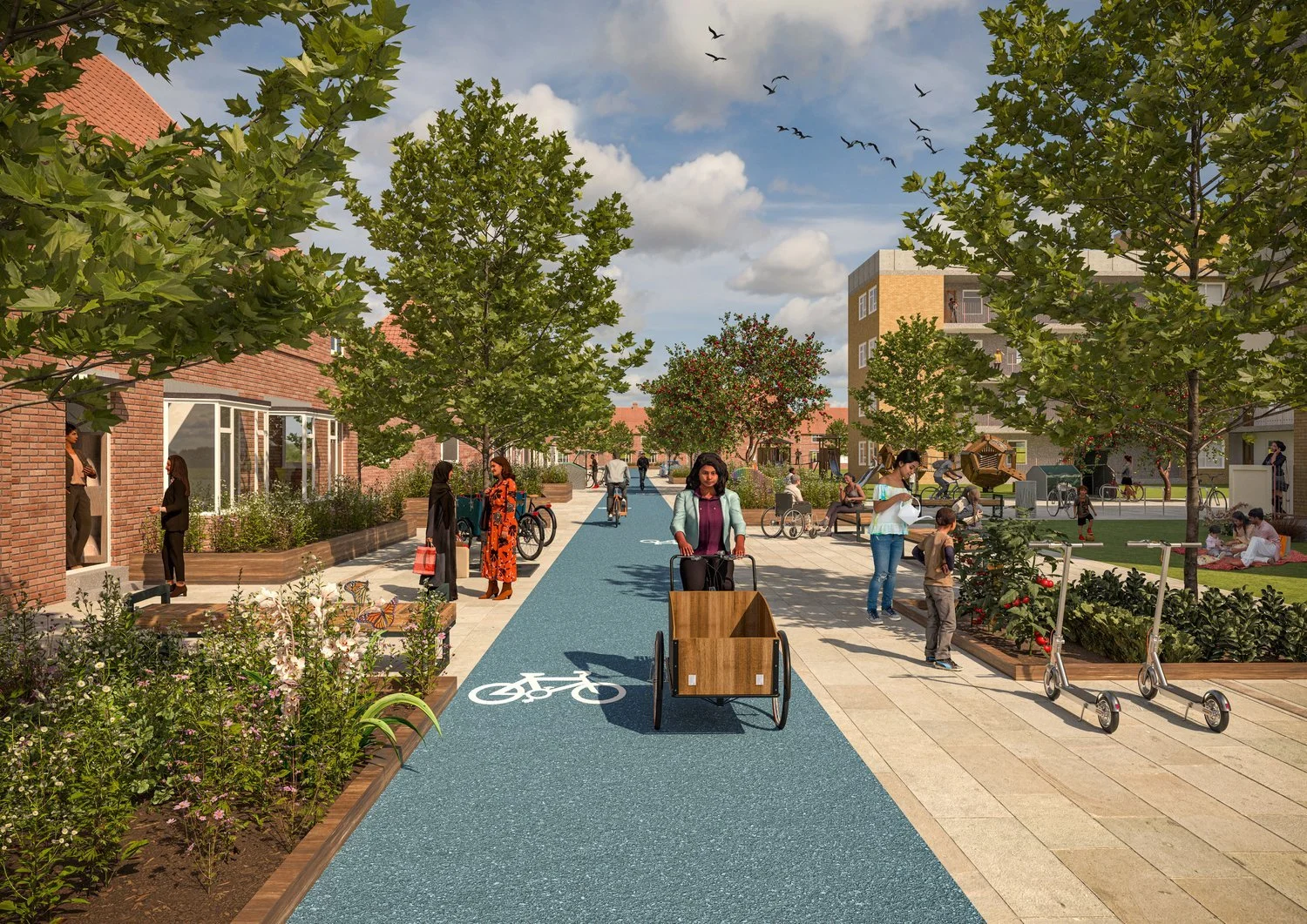
Reclaiming street space, cutting traffic noise, and making car ownership truly optional can transform the public realm into inspiring places for all.
[1] Stutzer, A. and Frey, B.S. (2008); Morris, E.A. et al. (2015).
[2] White, M.P. et al. (2013).
[3] Basner, M. et al. (2014); World Health Organization (2020).
[4] Saadaoui, R. et al. (2025).
[8] IT014C and IT033C.
[13] Saadaoui, R. et al. (2025).
[14] Gehl, J. (2011); White, M.P. et al. (2013).
[16] Basner, M. et al. (2014); World Health Organization (2020); Clark, C. and Paunovic, K. (2018).
[17] Dockery, D.W. et al. (1993); World Health Organization (2024).
[18] Duranton, G. and Turner, M.A. (2011).
[19] Basner, M. et al. (2014).
[20] Bruno, M. et al. (2024).
[21] Oswald, A.J. et al. (2015); Bellet, C.S. et al. (2024).
Last picture (Bottom right) from: https://www.wearepossible.org/carfreecities