2025-06-13
 0
0

The Impact of Subway Systems on Housing Prices in China’s Third-Tier Cities: Evidence from Wenzhou Based on the Hedonic Pricing Model
陈西缘 2200935002 蔡夏桓 2300935066
Introduction
In recent decades, a growing body of urban economics research has shown that rail-based transit accessibility is systematically capitalized into nearby housing values. A seminal meta-analysis by Debrezion, Pels, and Rietveld finds that, on average, residential property prices increase by roughly 2% for every 100 meters closer proximity to a station, reflecting savings in travel time and wider labor-market access (Debrezion, Pels, and Rietveld, 2007)[1]. Such effects emerge because new metro lines reduce commuting costs, relieve congestion, and spur agglomeration economies, thereby raising the willingness to pay for dwellings in station catchments.
Most empirical evidence derives from large‐city contexts, such as Beijing, London, Charlotte, where mature networks and high densities magnify capitalization effects. By contrast, third‐tier cities in economically advanced regions remain understudied. Wenzhou, a prefecture‐level city of some nine million residents in Zhejiang Province, offers a distinctive case. Although Zhejiang ranks among China’s wealthiest provinces, Wenzhou only opened its first metro line in 2019. Examining how nascent rail accessibility influences second‐hand housing prices here can extend our understanding of transit‐market linkages beyond megacities, offering both practical guidance for local land‐use and housing policy and a test of whether established capitalization patterns hold in smaller but economically dynamic settings.
About research
This study dives into the relationship between subway accessibility and housing prices in third-tier Chinese cities, using Wenzhou in Zhejiang Province as a case study. Leveraging the Hedonic Pricing Model, we apply a multiple linear regression approach to examine how proximity to subway stations, controlling other neighborhood and housing features, affects the price of second-hand residential properties.
The model we use is specified as follows:
Housing Price = β₀ + β₁·Distance to Subway Station + β₂·Number of Bus Stops + β₃·Primary School + β₄·Middle School + β₅·Mall + β₆·Low Floor + β₇·Decoration + ε
Ps: DV means Dummy Variable.
Data Collection
The dataset includes 757 second-hand residential listings located within 1.5 kilometers of stations on Wenzhou Metro Line 1. Data was scraped from the popular real estate platform Beike (贝壳找房). To investigate how housing prices vary by subway accessibility, we grouped the samples into three categories (metro_group 1–3) based on their distance from the nearest subway station.
Regression Analysis – Full Sample
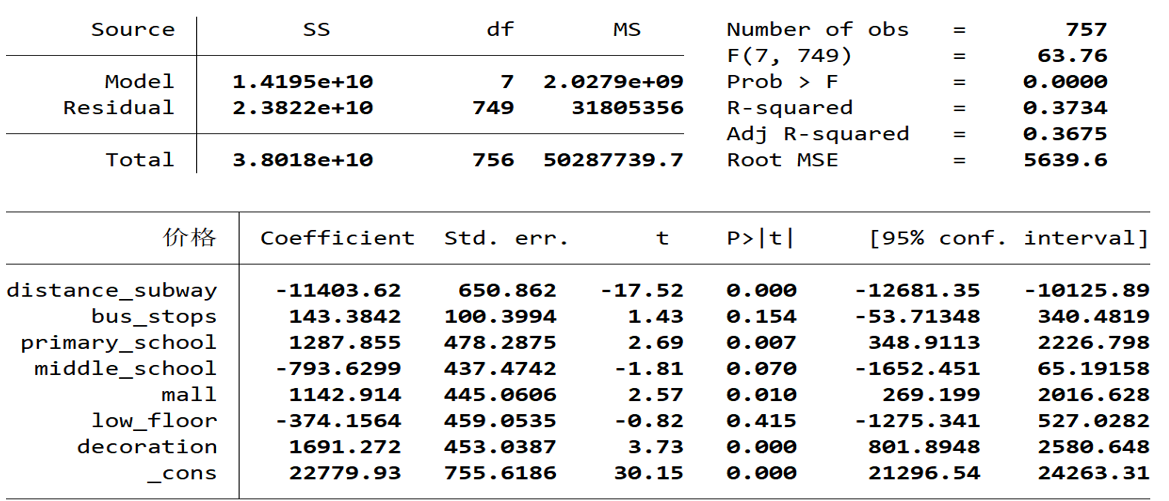
Regression results of all samples
From the results we can know that distance to subway stations has a statistically significant negative effect on housing prices (β=-11,403.62, p=0.001). The closer a property is to a subway station, the more expensive it tends to be. Every additional kilometer away from a station is associated with a price drop of about 11,403 RMB per square meter on average, holding all else constant.
Subgroup Regression Analysis
To explore how the subway’s pricing effect changes with distance, we divided the sample into three distance-based groups: 0–0.5 km from the nearest subway station (metro_group == 1), 0.5–1 km (metro_group == 2) and 1–1.5 km (metro_group == 3).
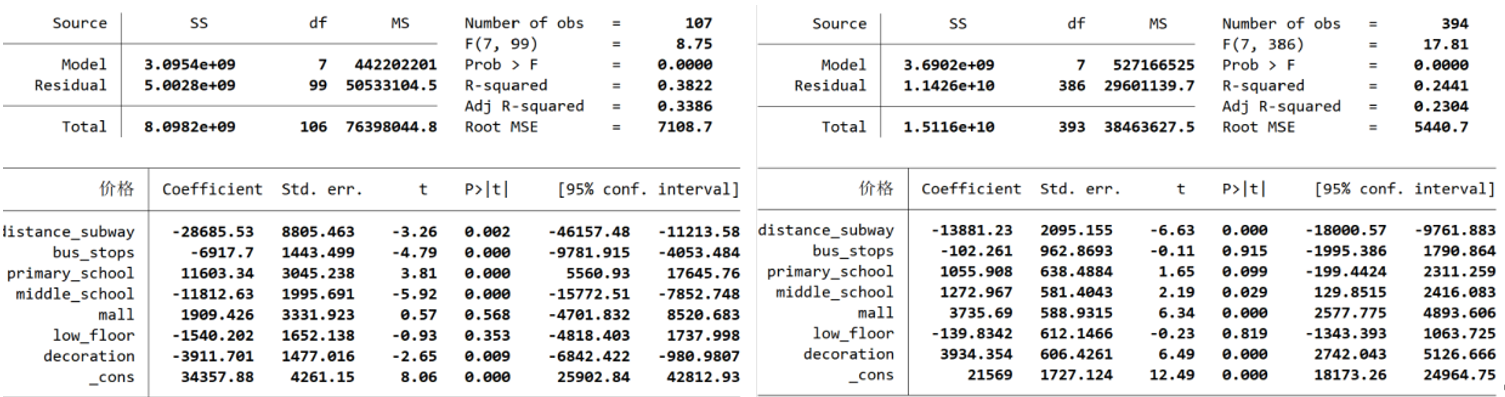
Regression results of metro_group == 1 & metro_group == 2
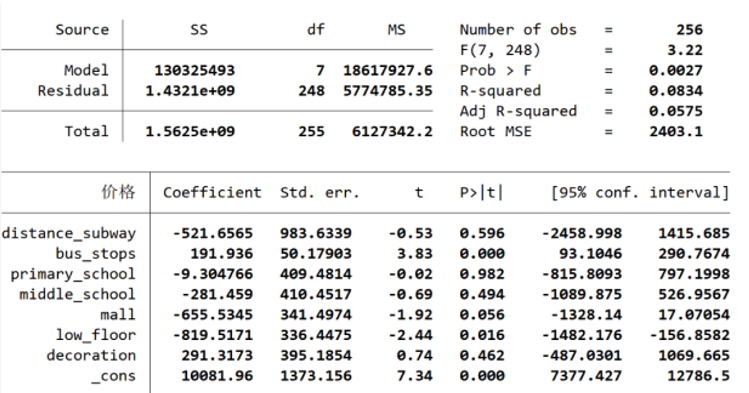
Regression results of metro_group == 3
The regression results clearly illustrate a distance-decay pattern in the subway premium effect:
Within 500 meters of a subway station, the effect is strongest. The coefficient for distance_subway is -28,685.53 (p=0.001), indicating that for every additional kilometer away from the station, housing prices drop by 28,685 RMB per square meter on average, holding all else constant. This suggests that within comfortable walking distance, subway access significantly boosts property values.
In the 500m–1km range, the negative effect of distance remains statistically significant (p=0.000), but the coefficient drops to -13,881. This indicates that although subway access still adds value, the premium weakens with distance.
Beyond 1 km, the distance to the subway station no longer has a significant effect on housing prices (p=0.596), suggesting that the marginal value of proximity essentially disappears beyond a certain threshold.
Interestingly, the results also highlight a complicated interaction between subway and bus accessibility, particularly in the context of third-tier cities:
Within 500 meters of a subway station, the number of bus stops has a significant negative effect on housing prices (coefficient=-6,917.7, p=0.001). This counterintuitive result may be due to the substitution effect of subways over buses, or negative externalities associated with dense bus networks, such as noise, congestion, and pollution.
Between 500 meters and 1 kilometer, the number of bus stops shows no significant impact on housing prices (p = 0.915).
Beyond 1 kilometer, the impact of bus accessibility turns significantly positive (coefficient=191.936, p=0.001). This shift indicates that in areas out of easy reach of the subway, bus infrastructure becomes a key value driver again. Buses likely act as connectors to the subway network, restoring some of the lost accessibility in outer zones.
Results and Discussion
Based on the data and analysis, we arrive at several key insights:
In third-tier cities, the impact of subway proximity on housing prices exhibits a clear distance-decay effect. The closer a property is to a subway station, the greater the price premium. However, this effect rapidly diminishes and becomes statistically insignificant beyond 1 kilometer.
There is evidence of a substitution relationship between subway and bus transportation. Closer to the subway, bus stops may even have a negative effect on property values, likely due to redundancy or environmental drawbacks. Conversely, in areas farther from the subway, bus accessibility becomes a valuable amenity, regaining its importance as a transportation lifeline.
These findings carry important implications for urban planning and transit-oriented development in third-tier cities:
Subway investments can do more than just ease congestion. They can substantially increase nearby property values. But this effect is spatially limited, concentrated mostly within 1 km of the stations.
In core subway zones, it may be efficient to reduce redundant bus routes. However, strengthening bus network and designing effective bus-subway integration systems could enhance regional connectivity and sustain property value growth in peripheral areas.
Explanation of AI usage
In this study, we utilized ChatGPT for assistance in Stata code writing, integrating results and ideas, and polishing blog text.
For the Stata code writing, we primarily communicated the data processing steps we intended to perform to the AI, which then generated the corresponding Stata command codes. We subsequently manually modified and applied the code as needed.
Regarding the integration of results and ideas, we first analyzed the regression results ourselves to derive the main points and conclusions. We then provided these to the AI to help refine them into more concise and logically coherent expressions. In this section, we wrote part of the text ourselves and selectively incorporated some AI-generated phrasing, followed by manual revisions.
For blog text polishing, to avoid basic grammatical and lexical errors, we used the AI to review the initial draft of blog for grammar checks and language refinement.
Apart from the aforementioned aspects, all other parts of the study were completed independently without AI assistance, including topic selection, research model design, data collection, and analysis.
[1] Debrezion, G., R. Pels, and P. Rietveld. 2007. “The Impact of Railway Stations on Residential and Commercial Property Value: A Meta‐analysis.” Journal of Real Estate Finance and Economics 35 (2): 161–80.