2025-06-15
 0
0

Blog 14 June 2025
 Authors: Xintong Zhang, Jiawen Zheng
E-hailing services have quickly risen in popularity and attracted both positive and negative attention. Operating with a largely unregulated supply of drivers, these e-hailing services have amassed a large customer base but also created difficulties for congested city centers. Meanwhile, with the improvement of living standards, the number of private cars is also increasing. Policies to alleviate congestion in the city center are imperative.
Description of traffic congestion policy
New York City is launching a congestion pricing program aimed at reducing traffic congestion in Manhattan below 60th Street. A base toll of $9 will be charged daily for vehicle entry into the congestion zone, with varying increased fees applied to small and large trucks, and a decreased fee for motorcycles. Fees are discounted by 75% during the off-peak hours of 9pm - 5am. Excluded from the toll are FDR Drive, the West Side Highway and the Hugh L. Carey Tunnel connecting to West Street. Aims of the program include reducing travel time and emissions, and raising money for the New York City transportation system.
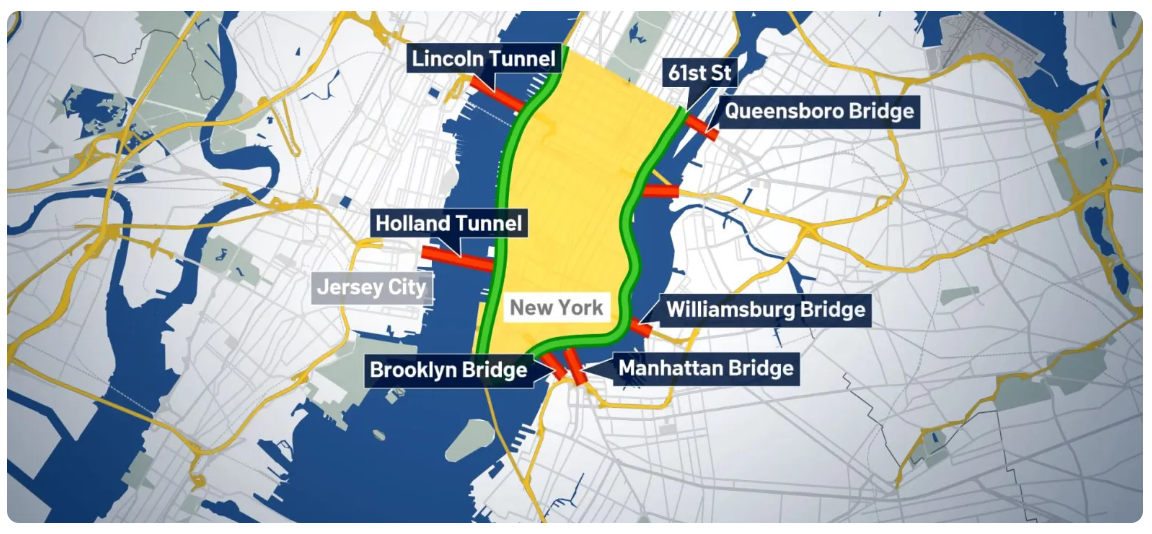 Figure 1: Congestion Zone Map
Experimental Overview and Results
Based on this policy, using the DiD model, weather and fuel prices were selected as control variables, and data from Chicago and Boston were introduced to conduct a comparative analysis of the 11-week workday data before and after the implementation of the policy, measured in weeks. The specific period is from December 9, 2024 to February 19, 2025, from 9 a.m. to 9 p.m. The indicator for measuring traffic congestion is the average commute time on the streets, which was referenced from Joshua Moshes and Benjamin Moshes. The data includes commute times for 17 streets in New York City and 2 streets in Boston and Chicago. Among the New York streets, 12 are located within the policy impact area, while the remaining streets are unaffected or minimally affected.
Our regression results are classified according to the presence or absence of time-fixed effects and control variables. The control variables selected are the frequency of bad weather occurrences per week, including the probabilities of rain and snow, as well as the weekly average fuel prices in the United States, all of which may influence car travel. We also conducted a parallel trend test. The following are the regression results, descriptive statistics, and parallel trend test graphs.
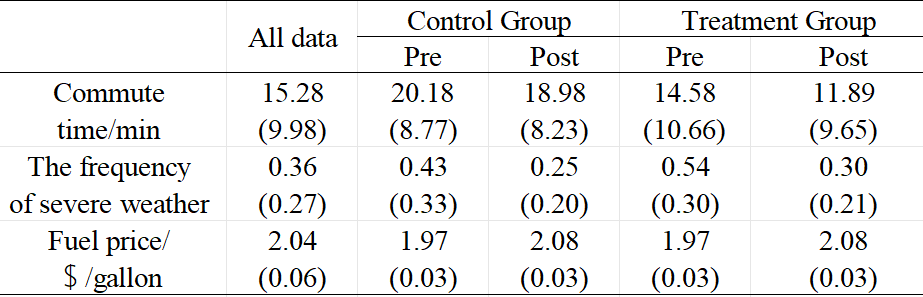
Figure 2: descriptive statistics
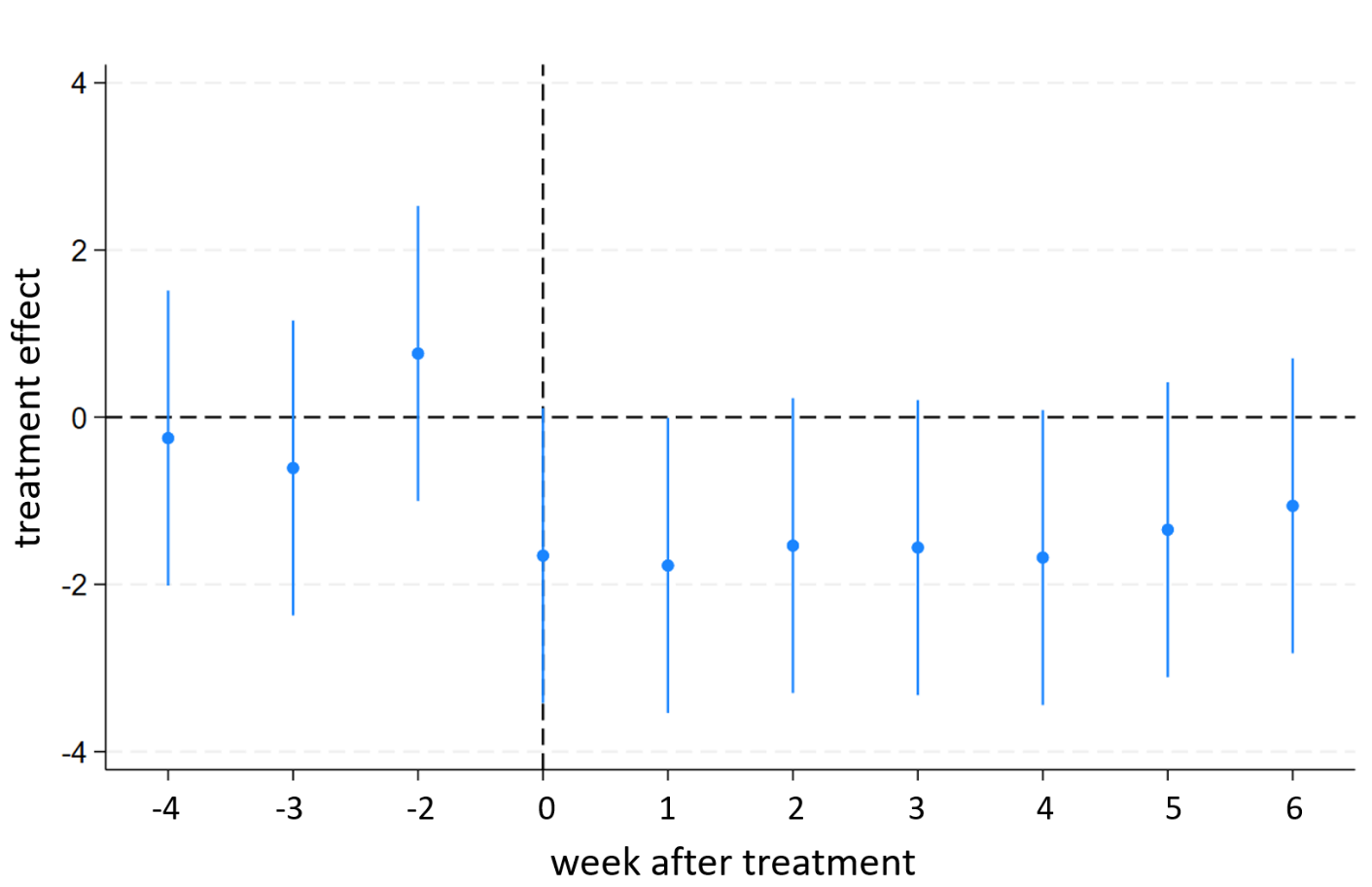
Figure 3: parallel trend test graphs
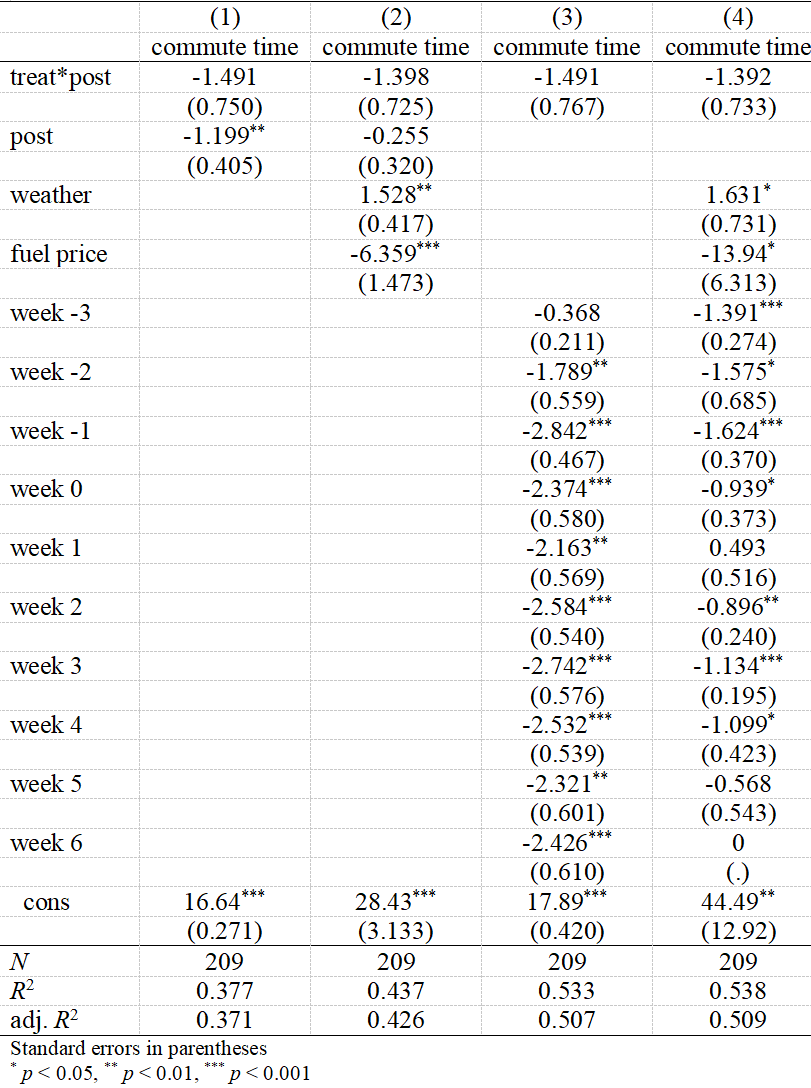
Figure 4: regression results
Note: In figure 2, (1) has individual fixed effect, no time fixed effect, and no control variables; (2) has individual fixed effect, no time fixed effect, and has control variables; (3) has individual fixed effect and time fixed effect, and has no control variables; (4) has individual fixed effect and time fixed effect, and has control variables.(3) and (4) use dummy variables for time fixed effect. The variable "week" in (3) and (4) refers to the nth week after the policy implementation.
Reason analysis
We found that the control variables had a significant impact on traffic congestion, which corresponds to common sense. The frequency of bad weather has a significant positive impact on congestion because people are more inclined to travel by car on rainy or snowy days. Conversely, fuel prices have a significant negative impact. However, the impact of the traffic congestion fee was consistently insignificant.
After the policy was implemented, the number of private cars entering the toll area decreased by 6%, but the proportion of taxis and ride-hailing vehicles increased by 7%, which partially offset the effect. Logistics vehicles still need to enter the toll area due to business requirements, although the cost is high, it is inevitable.
As the global economic center, New York has maintained continuous economic growth during the policy implementation period, attracting more employment and population inflows, which offset the diversion effect of the congestion fee. Furthermore, some drivers avoid the costs by means such as carpooling and adjusting their commuting times, which has led to a gradual weakening of the policy's effectiveness over time.
The low-income discount needs to be declared annually and relies on the vehicle owner to voluntarily provide income proof. There may be cases of underreporting or abuse. Although 1,400 cameras have been installed, the identification and enforcement of exempt vehicles still depend on manual review, resulting in limited efficiency. Moreover, some drivers use fake license plates or fail to pay, causing the actual collection rate to be lower than expected.
Conclusion
The main reason why the congestion fee policy in New York has not achieved significant results lies in the combined effect of design flaws and insufficient implementation, as well as external environmental challenges. The policy needs to expand its coverage, increase the fee standards, reduce exemptions, and simultaneously enhance the capacity and reliability of public transportation.
Additionally, it is necessary to strengthen law enforcement, extend the evaluation period, and draw on dynamic pricing and flexible exemption mechanisms from cities like London. Without systematic reforms and relying solely on a single charging measure, the traffic congestion problem in New York is unlikely to be fundamentally resolved.