2025-06-15
 0
0

Blog · June 15, 2025 · Yuxin Sun(孙予欣) & Rongjian Su(苏荣键)
Working from home (WFH) has become a global mainstream, with its prevalence in the U.S. stabilizing near 30% post-pandemic (Ramani, Alcedo, & Bloom, 2024; Barrero, Bloom, & Davis, 2023) and acceptance growing in China (PwC, 2023). While often seen as a boon for well-being, its effects are highly contextual. The impact of WFH hinges on whether it is a voluntarily chosen benefit, which is linked to higher satisfaction (Shamir & Salomon, 1985), or a passively accepted arrangement that can cause distress (Hu & Subramony, 2022). Though hybrid work offers flexibility (Halford, 2005; Naqshbandi & Jasimuddin, 2022), it can also amplify "Work-Family Conflict" (WFC) by blurring the boundaries between personal and professional life (Greenhaus & Beutell, 1985). Existing research reflects this tension: while well-designed hybrid policies can boost satisfaction and retention (Bloom, Han, & Liang, 2024), WFH can also harm well-being by intensifying WFC, particularly for women (Uddin, 2021; Shaari, Sarip, & Shaari, 2022), with effects varying by career stage (Ibarra, Gillard, & Chamorro-Premuzic, 2020). This study, therefore, investigates whether WFH is a boon or a bane for happiness in the general context of China
Spatial Differences in Hybrid Work and Happiness
To investigate the true relationship between hybrid work and happiness, we use data from the China Family Panel Studies (CFPS), a high-quality, nationally representative longitudinal survey that provides a solid data foundation for this research (Xie & Hu, 2014). By analyzing data covering 28,117 individuals across three waves from 2018 to 2022, we can observe changes in individuals' real lives. Our analysis reveals that "hybrid workers," for whom home is the primary workplace, constitute only 3% of the sample, indicating that this model remains relatively uncommon in China.
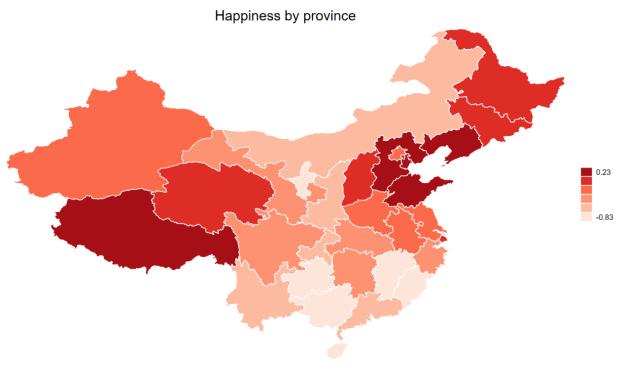
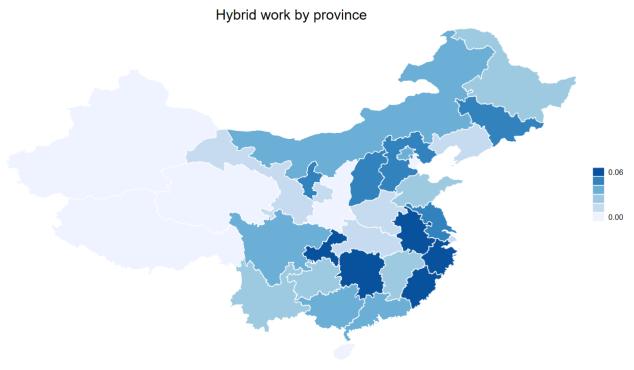
Figure 1. Heatmaps of Happiness & Hybrid Work Prevalence (by Province)
Note: The left map displays happiness levels by province, and the right map displays the proportion of hybrid work. In both maps, a darker color indicates a higher value.
The happiness map reveals that well-being is not strictly tied to economic development. The hybrid work map shows a clear concentration in coastal provinces, likely reflecting their industrial structures and the prevalence of suitable occupations.
A Counterintuitive Reality
Table 1 present summary statistics among this subsample of CFPS.
Table 1: Summary Statistics
Variable | N | Mean | SD |
urban | 28117 | 0.63 | 0.48 |
age | 28117 | 39.35 | 12.13 |
gender | 28117 | 0.58 | 0.49 |
income | 28117 | 48401 | 48359 |
happiness | 28117 | 0 | 1 |
hybrid | 28117 | 0.03 | 0.16 |
Using a fixed-effects model to control for time-invariant individual traits, we also found that hybrid work is significantly associated with lower happiness. Table 2 shows that on average, this effect corresponds to a decrease of 0.0922 standard deviations (p<0.05), a conclusion that proved robust across various model specifications.
Table 2: Baseline Regression
Dependent Variable | Happiness | |||
(1) | (2) | (3) | (4) | |
Hybrid (=1 if hybrid work) | -0.134*** | -0.0973** | -0.0931** | -0.0922** |
(0.0425) | (0.0414) | (0.0414) | (0.0412) | |
Control Variables | No | Yes | Yes | Yes |
Time FE | No | Yes | No | Yes |
Province FE | No | No | Yes | Yes |
Constant | Yes | Yes | Yes | Yes |
Observations | 28,117 | 28,117 | 28,117 | 28,117 |
R-squared | 0.000 | 0.012 | 0.025 | 0.027 |
Notes: Standard errors are clustered at the county level. Controls include gender, age, occupation, education level, income, marital status, etc.Significance levels of 1%, 5%, and 10% are denoted by ***, **, and *, respectively.
Digging Deeper: Who is Unhappy?
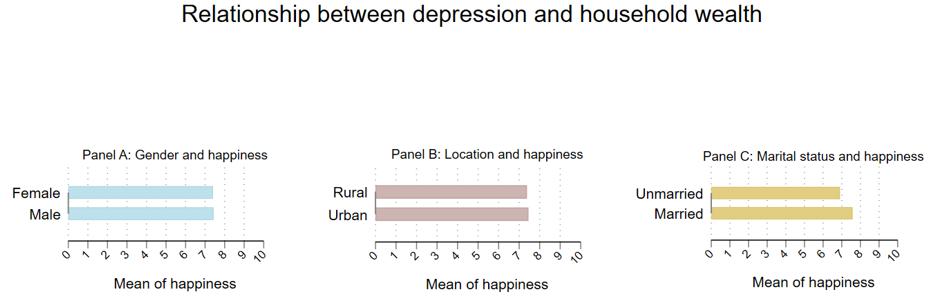
Figure 2. Heterogeneity Analysis
When we segment the population, the true protagonists of this story become clear. Figure 2 and Table 3 shows that:
Significant Impact on the Married Cohort: Compared to their office-based peers, married individuals who work from home experience an average happiness decrease of 0.0998 standard deviations (p<0.05), while no significant change is observed for unmarried individuals. This finding is consistent with "Work-Family Conflict" theory.
A Marginally Significant Urban-Rural Difference: For the urban population, working from home is associated with a happiness decrease of 0.0984 standard deviations (p<0.1) compared to office work, whereas no significant effect is found in rural areas.
Table 3 Heterogeneity Analysis
Dependent Variable | Happiness | |||
urban | rural | Married | Unmarried | |
(1) | (2) | (3) | (4) | |
Hybrid | -0.0984* | -0.0794 | -0.0998** | -0.0143 |
(0.0536) | (0.0665) | (0.0437) | (0.127) | |
Control Variables | No | Yes | Yes | Yes |
Time FE | No | Yes | No | Yes |
Province FE | No | No | Yes | Yes |
Constant | Yes | Yes | Yes | Yes |
Observations | 17,803 | 10,314 | 21,705 | 6,412 |
R-squared | 0.025 | 0.035 | 0.026 | 0.061 |
Notes: Standard errors are clustered at the county level. Controls include gender, age, occupation, education level, income, marital status, etc.Significance levels of 1%, 5%, and 10% are denoted by ***, **, and *, respectively.
From Findings to Reflection: What Does This Mean?
Our research indicates that in China, hybrid work is not a panacea for happiness; it brings unexpected negative effects for married and urban populations. The deeper reason may be rooted in the more blurred public-private boundaries of a collectivist cultural context.
When work intrudes upon the family space—a space laden with tight-knit relationships and multiple role expectations—it can trigger a more intense role conflict (Yang, Chen, Choi, & Zou, 2000). This finding offers an insight: for individuals living in fast-paced, high-pressure urban environments, simply replacing the daily commute with WFH may not be a Pareto improvement. If hybrid work reduces the subjective well-being of the core urban workforce, it could, in the long run, affect a city's appeal for talent, the vitality of its central business districts, and even the evolution of its urban spatial structure.
Acknowledgements
We thank our professor, TA, and classmates for their insightful feedback and support on this project.
References
Barrero, J. M., Bloom, N., & Davis, S. J. (2023). The evolution of work from home. Journal of Economic Perspectives, 37(4), 23-49.
Bloom, N., Han, R., & Liang, J. (2024). Hybrid working from home improves retention without damaging performance. Nature, 630(8018), 920-925.
Greenhaus, J. H., & Beutell, N. J. 1985. Sources of conflict between work and family roles. Academy of Management Review, 10: 76-88.
Halford, S. (2005). Hybrid workspace: Re‐spatialisations of work, organisation and management. New Technology, Work and Employment, 20(1), 19-33.
Hu, X., & Subramony, M. (2022). Disruptive pandemic effects on telecommuters: A longitudinal study of work–family balance and well‐being during COVID‐19. Applied Psychology, 71(3), 807-826.
Ibarra, H., Gillard, J., & Chamorro-Premuzic, T. (2020). Why WFH isn’t necessarily good for women. Harvard Business Review, 7.
Naqshbandi, M. M., & Jasimuddin, S. M. (2022). The linkage between open innovation, absorptive capacity and managerial ties: A cross-country perspective. Journal of Innovation & Knowledge, 7(2), 100167.
Ramani, A., Alcedo, J., & Bloom, N. (2024). How working from home reshapes cities. Proceedings of the National Academy of Sciences, 121(45), e2408930121.
Shaari, R., Sarip, A., & Shaari, S. (2022). Work-family Balance and Hybrid Working Environment for Women: An Agenda. Sciences, 12(12), 1726-1733.
Shamir, B., & Salomon, I. (1985). Work-at-home and the quality of working life. Academy of Management Review, 10(3), 455-464.
Uddin, M. (2021). Addressing work‐life balance challenges of working women during COVID‐19 in Bangladesh. International Social Science Journal, 71(239-240), 7-20.
Working from home around the globe: 2023 Report; PwC “《期待与忐忑:职场人的心声》 ”
Xie, Y., & Hu, J. (2014). An introduction to the China family panel studies (CFPS). Chinese sociological review, 47(1), 3-29.
Yang, N., Chen, C. C., Choi, J., & Zou, Y. (2000). Sources of work‐family conflict: A Sino‐US comparison of the effects of work and family demands. Academy of Management journal, 43(1), 113-123.
AI Usage Note
AI was utilized as an auxiliary tool in the writing of this research and article. Its application was primarily in the following areas:
l Translation and Polishing: Used to assist in the comprehension of English literature and for the initial translation and stylistic refinement of the manuscript.
l Interpretation and Condensation: Used to assist in converting statistical data (e.g., regression results) into textual descriptions, and to condense the text and simplify its length as required.