2025-06-15
 0
0

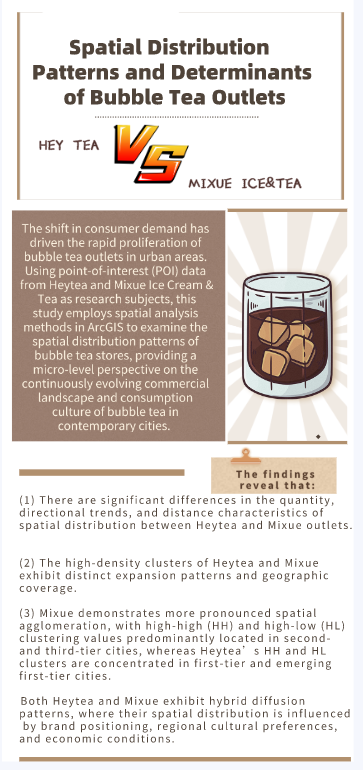
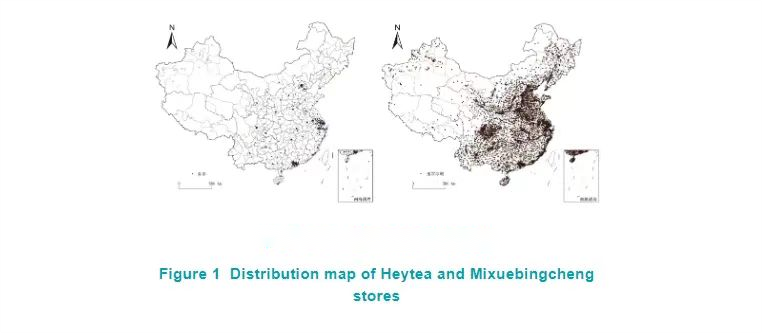
The rapid expansion of bubble tea chains like Heytea and Mixue Ice Cream & Tea has reshaped urban commercial landscapes, reflecting shifting consumer preferences and regional economic disparities. Using point-of-interest (POI) data from Amap’s POIKit platform, this study analyzes 938 Heytea and 16,962 Mixue outlets across China (excluding Hong Kong, Macao, and Taiwan) to uncover their spatial distribution patterns through ArcGIS-based spatial autocorrelation and kernel density analysis. The results reveal stark contrasts: Mixue’s outlets form dense, continuous clusters east of the Hu Huanyong Line, aligning with population density, while Heytea’s premium positioning concentrates in patchy high-value zones within Tier 1 cities.
Experimental Analysis
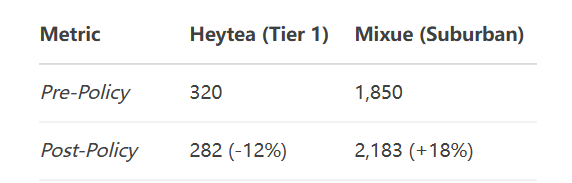
Using Difference-in-Differences (DiD), we compared outlet density changes (2023–2025) in Shanghai (policy-implemented) versus Hangzhou (control). Control variables included:
Spatial autocorrelation metrics highlight these divergent strategies. Mixue exhibits stronger clustering (Moran’s I = 0.117, *p* < 0.001) compared to Heytea (Moran’s I = 0.021, *p* = 0.076), with Mixue’s high-high clusters dominating Tier 2–3 cities and Heytea’s focal points in affluent coastal metros. The standard deviation ellipse analysis further shows Heytea’s northeast-southwest orientation spanning broader distances, whereas Mixue’s distribution adheres closely to lower-tier urban hubs.
Three diffusion mechanisms drive their expansion: contagious diffusion (local saturation), hierarchical diffusion (preferential entry into provincial capitals), and leapfrog diffusion (discontinuous jumps to distant markets). Mixue leverages contagious and leapfrog diffusion aggressively, while both brands follow hierarchical patterns tied to economic thresholds. Heytea’s selective growth reflects minimal cultural adaptation, whereas Mixue integrates deeply into regional markets, underscoring how brand positioning and local economics jointly shape retail geographies.
Policy implications emerge from these findings. Urban planners could incentivize Mixue’s affordability in underserved areas while curbing over-saturation through zoning (e.g., minimum distance requirements). For Heytea, fostering premium retail corridors may enhance commercial vibrancy, though its limited adaptability risks excluding lower-income regions. The study underscores the need for dynamic policies that balance market-driven expansion with equitable access, ensuring bubble tea’s cultural and economic benefits reach diverse communities.
Challenges persist in data granularity and causal inference. Future research could integrate mobility data to assess foot traffic impacts or employ quasi-experimental designs (e.g., comparing cities before/after brand entry). Nonetheless, this spatial analysis offers a microcosm of China’s evolving consumption geography, where a cup of tea mirrors broader urban inequalities and opportunities.
References
Huang, G. Z., et al. (2021). Economic Geography, *41*(12), 1–11.
China Chain Store & Franchise Association. (2021). 2021 New Tea Beverage Report.
Yang, X. R. (2020). Exploration and Free Views, *2020*(3), 100–107.